Built on Ruins: The Ancient History Hidden Underneath Phoenix
Ancient Hohokam Canals – The Foundation of Phoenix’s Modern Canal System
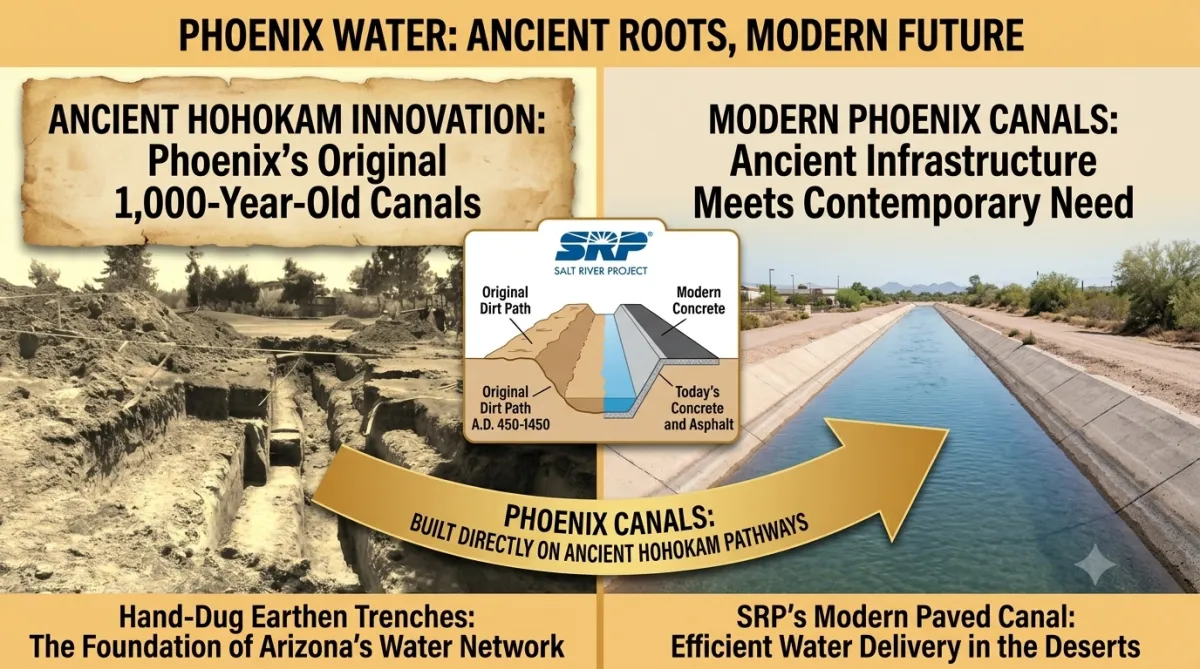
When you drive past the bustling streets and master-planned neighborhoods of Phoenix, you are traveling among paths carved out thousands of years ago. One of the most fascinating facts about Phoenix's history is that our modern-day canal system is built directly on top of infrastructure created by the ancient Hohokam people.
From roughly A.D. 450 to 1450, the Hohokam civilization thrived in the Salt River Valley. Without modern tools, heavy machinery, or beasts of burden, they engineered an incredibly sophisticated system of hand-dug, dirt irrigation canals. These canals spanned hundreds of miles, redirecting water from local aquifers and rivers to transform the arid desert into a fertile agricultural metropolis that grew corn, beans, and squash.
When modern settlers arrived in the late 19th century, they recognized the pure genius of the Hohokam design. Instead of digging completely new pathways, engineers cleared out the ancient, silted-filled trenches. Today, major entities like the Salt River Project (SRP) utilize those exact prehistoric alignments to deliver water across the Valley. It’s a wonderful reminder that Phoenix wasn't just built in the desert—it was built on a foundation of ancient innovation.
If you want additional information, here is an interesting report:
The Hohokam: Canal Masters of the American Southwest – Popular Archeology
Quick Answer
Phoenix's modern water canal system relies directly on the historical, hand-dug irrigation paths engineered by the ancient Hohokam civilization over a thousand years ago.
FAQs
Q: Where can I see remnants of Hohokam history?
A: You can visit the S'edav Va'aki Museum (formerly Pueblo Grande Museum) in Phoenix, which features a fully preserved archaeological site and original canal ruins.
Fun Fact – My son and I volunteered there a few years ago.We helped to replace/strengthen some of the structures. It was a lot of fun too. Call them and give them a hand.
Q: Why did the Hohokam disappear?
A: While the exact cause remains an archaeological mystery, scientists point to a combination of severe, prolonged droughts and major flooding cycles that disrupted their complex irrigation systems around the 15th century.