Architects Who Defined Mid-Century Modern Phoenix | Haver, Beadle & More
The Visionaries Behind Phoenix's Mid-Century Architecture
Greater Phoenix is home to one of the richest collections of mid-century modern architecture in the American Southwest. The Valley's post-war population boom attracted a remarkable group of architects who used the desert landscape — its light, heat, and open space — as both inspiration and constraint. Their work helped define a uniquely Phoenician style of modernism that still captivates homebuyers, design enthusiasts, and historians today.
Here are the key architects whose work shaped the mid-century modern character of Greater Phoenix.
Ralph Haver — The Father of the 'Haverhood'
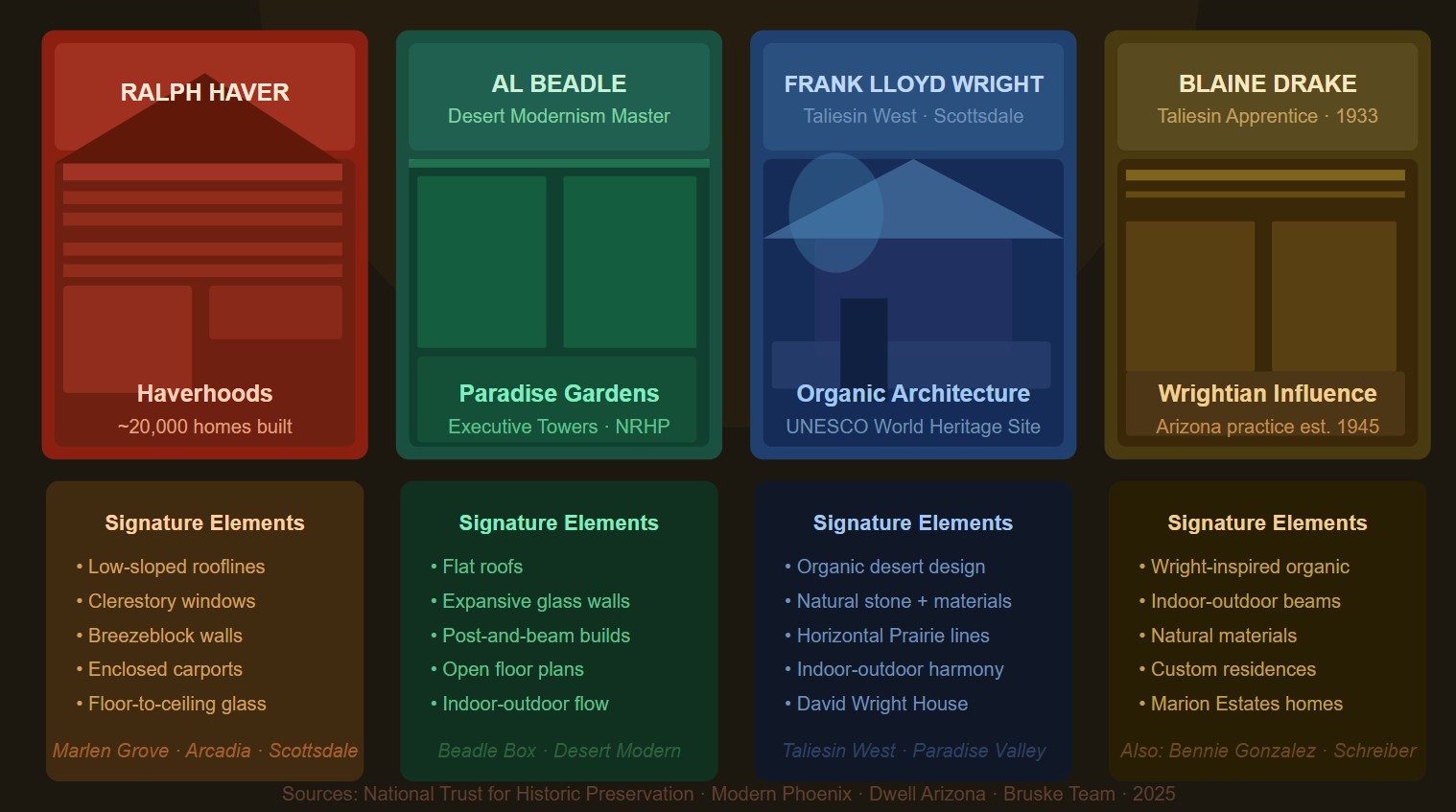
Some argue that no architect left a larger residential footprint on Phoenix than Ralph Haver. Working primarily in the 1950s and early 1960s, Haver developed entire subdivisions — now lovingly called 'Haverhoods' — that combined modernist design principles with accessible price points. His homes are characterized by low-sloped rooflines, clerestory windows, floor-to-ceiling walls of glass, brick or block construction, and enclosed carports designed for indoor-outdoor living.
It is estimated there are approximately 20,000 Haver-designed homes across Arizona, New Mexico, and Colorado. His neighborhoods — including Marlen Grove, Windemere in Arcadia, and Town & Country in Scottsdale — are now among the most desirable addresses in the Valley.
Alfred Newman Beadle (Al Beadle) — Desert Modernism Master
Described by the National Trust for Historic Preservation as 'a pioneer of desert Modernism,' Al Beadle arrived in Phoenix after serving with the U.S. Navy's Seabees in World War II — where he learned construction firsthand. Without formal architecture school training, he became one of the most coveted designers of sleekly modern homes, offices, restaurants, and apartment buildings in the city.
Beadle's signature style features clean lines, flat roofs, expansive glass walls, and a seamless integration of interior and exterior space. His most iconic residential project, Paradise Gardens, developed between 1958 and 1964, showcases post-and-beam construction, open floor plans, and large windows that blur the boundary between indoors and the desert outside. His Executive Towers, a 21-story high-rise in Uptown Phoenix, is now on the National Register of Historic Places.
Frank Lloyd Wright — Taliesin West and Desert Organic Architecture
Frank Lloyd Wright's presence in the Phoenix area is impossible to overstate. His winter home and school, Taliesin West in Scottsdale, remains one of the most celebrated works of American architecture — a masterpiece of organic design that works with the desert rather than against it. Wright's influence rippled through generations of Phoenix architects, shaping how the Valley thinks about indoor-outdoor living, natural materials, and horizontal design.
One of Wright's most beloved local residential designs is the David and Gladys Wright House in Phoenix, a stunning spiral-form home described as one of his last residential masterpieces.
Blaine Drake — A Wright Apprentice
Blaine Drake was one of Frank Lloyd Wright's original apprentices at Taliesin in Wisconsin in 1933, and he established his Arizona practice in 1945. His work reflects Wrightian principles of organic architecture and indoor-outdoor connection, and he contributed homes to several of Phoenix's most distinguished mid-century neighborhoods, including Marion Estates.
Bennie Gonzalez and Others
Other architects who contributed meaningfully to mid-century Phoenix include Bennie Gonzalez, Charles Schreiber, Calvin Straub, and Edward Varney — each contributing distinct voices to what became a uniquely Arizona modernist tradition.
Quick Answer: The architects who most shaped mid-century modern Phoenix include Ralph Haver (creator of the beloved 'Haverhoods'), Al Beadle (desert modernism master and designer of Paradise Gardens and Executive Towers), Frank Lloyd Wright (Taliesin West and David Wright House), and Blaine Drake (a Wright apprentice who established an Arizona practice in 1945).
Frequently Asked Questions
Q: Can I visit examples of mid-century modern architecture in Phoenix?
Yes! Taliesin West (Frank Lloyd Wright's desert campus) in Scottsdale offers regular tours and is a UNESCO World Heritage Site. The Modern Phoenix organization also hosts an annual home tour that grants access to restored mid-century residences across the Valley.
Q: What makes Al Beadle's homes different from Haver homes?
Haver homes were primarily designed as affordable tract housing — recognizable by their breezeblocks, low rooflines, and carports. Beadle's work tends to be more austere and Bauhaus-influenced, with flat roofs, expansive glass walls, and a more minimal, rectilinear design language. Both are beloved for very different reasons.
Q: Are Frank Lloyd Wright homes available to purchase in Phoenix?
True Wright-designed homes are exceedingly rare and when they come to market, they command significant premiums. However, homes designed by Wright's apprentices and those clearly inspired by his Taliesin school of thought do appear in the Greater Phoenix market, particularly in Paradise Valley and the Scottsdale area.