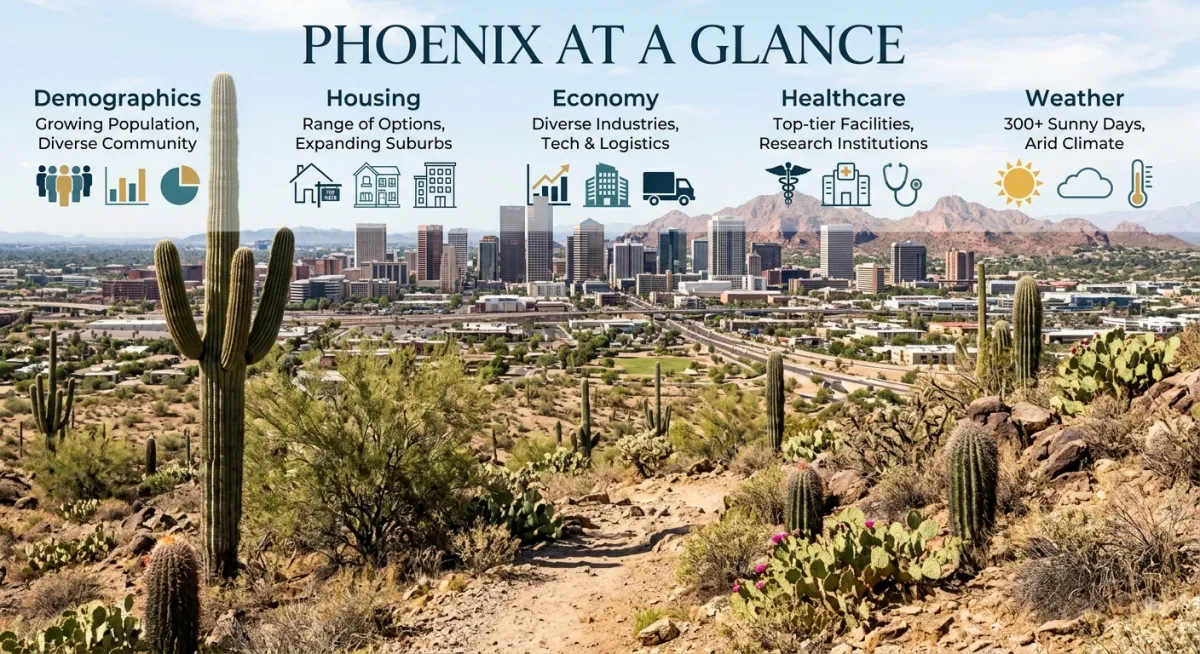
Phoenix at a Glance: Housing, Cost of Living & Local Trends (2026 Review)
Review of the City of Phoenix – Demographics, Housing, Economy, Weather, and Healthcare
Phoenix is the fifth-largest city in the United States, home to about 1.65 million people spread across 517 square miles. With roughly 300 days of sunshine each year, a growing job market, and a wide range of housing options, it continues to attract homebuyers from across the country. If you are considering making the move in 2026, it helps to look at the full picture, from home prices and rents to commuting patterns and cost-of-living details, so you can plan with confidence.
Phoenix at a Glance: Population, Age, and Income
The city has a population of approximately 1,657,609 residents. The median age in Phoenix is 34.1, making it a relatively youthful city compared to many other metro areas. Median household income figures vary depending on the source. U.S. News reports a median household income of $84,130, while Zillow (April 2026) puts the figure at $95,426. These differences reflect different survey periods and methodologies, but both point to a city where household earnings are above the national average.
Phoenix Housing Market in 2026
Home values in Phoenix have climbed in recent years, though they remain more affordable than coastal cities like Los Angeles or San Francisco. Data from multiple sources gives a range rather than a single number. U.S. News lists the median home value at $451,684, while Zillow reports a typical home value of $448,933 as of April 2026. PayScale, which may use median list price rather than appraised value, reports a median home price of $599,825. The variation underscores the importance of checking current listings with a local real estate professional.
Rents also differ by source. U.S. News shows a median rent of $1,554, Zillow reports $1,741, and PayScale indicates $1,800. The differences likely stem from varying time periods and whether the data includes all unit types or only certain rental categories. Using the 30% rent-to-income rule, Zillow estimates that a household needs $69,622 per year in income to afford the typical rent. For those looking to buy a median-priced home with a 20% down payment, the required income is $108,008 per year, with a total monthly homeownership cost of $2,700 (including mortgage, insurance, taxes, and maintenance).
Housing Expenses
As noted, housing in Phoenix costs 12% more than the U.S. average. This is largely driven by strong demand and limited inventory in many neighborhoods. Buyers should expect to budget carefully, especially if they are targeting a 20% down payment to avoid private mortgage insurance. Even with higher costs, Phoenix remains more affordable than many other large Sun Belt cities.
Utilities and Transportation
Utility bills in Phoenix are 6% higher than the national average, which comes as little surprise given the intense summer heat. Air conditioning use from June through September can push electricity costs higher. The cost of water can add up. But if you move into a home with irrigation watering, that can be a significant savings. Transportation costs are 9% above average, largely because the city is car-dependent. About 79.3% of commuters drive to work, and only 1.9% use public transit. The average commute time is roughly 23 minutes, which is close to the national average and manageable for most workers.
Groceries and Healthcare
Grocery prices in Phoenix sit 3% above the national average. While not a dramatic difference, it is something to factor into monthly budgets. Healthcare costs, on the other hand, are 4% below the national average, which can be a meaningful advantage for families and older adults who have regular medical expenses.
Cost of Living in Phoenix
Based on the above information, overall, the cost of living in Phoenix is 5% higher than the national average according to PayScale. The biggest factor is housing. Utility prices, transportation expenses, and grocery prices are also factors increasing cost of living.While healthcare costs in Phoenix can offset some other expenses for families and retirees.
Weather and Climate in Phoenix
Phoenix is famous for its sunny weather. The city receives about 300 days of sunshine per year. Winter temperatures are mild: the average low in January is 45°F and the high is 68°F. Spring and fall are comfortable, with seasonal averages near 76°F and 78°F respectively. Summer is intense. Between June and September, temperatures often exceed 110°F, and the average summer temperature sits around 95°F. For people who love heat and dry conditions, this is a major draw. Others may need to plan for trips to cooler climates, indoor activities and pool access during the hottest months.
Economy and Job Market
Phoenix added 14,200 jobs in 2025, representing 0.6% growth, according to Zillow. The unemployment rate is low, 4.9% per Bureau of Labor Statistics, which points to a generally moderate labor market. Major sectors include healthcare, technology, construction, and services. The city’s population growth continues to attract employers, and the relatively low cost of living compared to coastal hubs makes it appealing for businesses expanding their footprint.
Quick Answer – Is Phoenix Right for You?
With a sunny climate, a growing job market, and a median age of 34.1, Phoenix appeals to a wide range of homebuyers, from young professionals and families to retirees. Housing costs are higher than the national average, but still reasonable when compared with other large metro areas. The car-dependent layout means commuting by car is the norm, and the 23-minute average commute is considered manageable. Whether you are looking at a suburban home with a pool or a downtown condo, working with a local Realtor who knows the neighborhoods and the market can make the process smoother. Contact Marty Kudler to discuss your Phoenix home search and get personalized guidance every step of the way.
FAQs
Q: How much do I need to earn to buy a home in Phoenix in 2026?
A: Based on Zillow data, the income needed to afford a home with a 20% down payment is $108,008 per year. This covers mortgage, insurance, taxes, and maintenance, which total about $2,700 per month. Your personal financial situation and chosen neighborhood may affect this number.
Q: Is Phoenix an expensive place to live?
A: The cost of living in Phoenix is 5% higher than the national average, driven primarily by housing (12% above average) and utilities (6% above average). However, healthcare costs are 4% lower, and the city remains more affordable than many large coastal cities.
Q: What is the weather like year-round in Phoenix?
A: Phoenix experiences about 300 days of sunshine annually. Winter averages range from 45°F to 68°F, spring and fall are mild (mid-70s to low 80s), and summer temperatures often surpass 110°F between June and September. The average summer temperature is 95°F.
Q: How is the job market in Phoenix?
A: The Phoenix area added 14,200 jobs in 2025, a 0.6% increase. The unemployment rate is around 4.9%, which indicates a somewhat stable economy. Key industries include healthcare, technology, construction, and services.