Is Phoenix Arizona in a Housing Bubble? Facts, Data, and Real Estate Truths
Is the Phoenix Real Estate Market Going to Crash Soon???
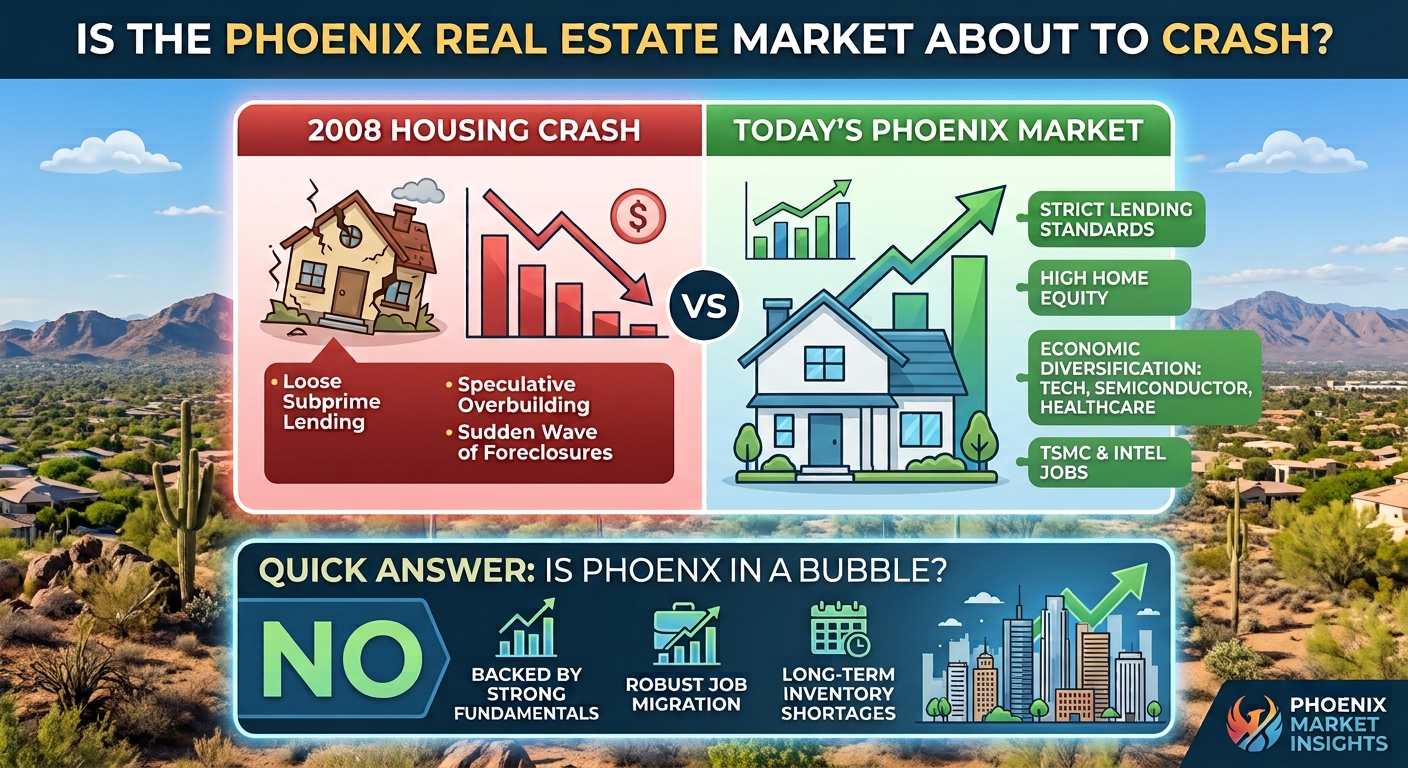
A common question buyers ask today is: "Is the Phoenix real estate market about to crash?" It is easy to compare current home prices to the 2008 housing crash, but local real estate economists from the Arizona State University W. P. Carey School of Business and the Cromford Report highlight critical structural differences.
Back in 2008, the crash was triggered by loose subprime lending, speculative overbuilding, and a sudden wave of foreclosures. Today's market dynamics are fundamentally different. First, stricter lending standards mean home equity across Maricopa County is at record highs. Second, Arizona has experienced massive economic diversification; major tech, semiconductor (TSMC), and healthcare employers have created thousands of high-paying jobs.
While interest rate shifts have moderated rapid appreciation, housing supply remains tight relative to population growth. Instead of a bubble bursting, experts describe Phoenix as a balanced, mature market adjusting to normalized interest rates. Prices remain supported by fundamental supply and demand mechanics.
Quick Answer
Is Phoenix in a real estate bubble? No. Unlike the 2008 crash, Phoenix market fundamentals are backed by stricter mortgage underwriting, strong job migration (e.g., TSMC, Intel expansion), and persistent long-term inventory shortages.
Frequently Asked Questions (FAQs)
Q: Will Phoenix home prices drop significantly soon?
oA: Real estate analysts expect slower, steady price growth or seasonal plateaus rather than significant price drops due to ongoing population migration into Arizona.
Q: What is driving job growth in the Phoenix area?
oA: Phoenix has become a major technology and advanced manufacturing hub, highlighted by multi-billion-dollar investments from TSMC in North Phoenix and Intel in Chandler.
Q: Is now a good time to buy a home in Phoenix?
oA: Buyers today face less competition than during peak bidding wars, giving them room to negotiate seller credits and interest rate buy-downs.